Source: NATURE|Vol 435|9 June 2005; Nature
PublishingGroup © 2005;
Sent to us by Anne Blanchard
To protect the integrity of science, we must look beyond
falsification, fabrication and plagiarism, to a wider range of
questionable research practices; argue Brian C. Martinson, Melissa S.
Anderson and Raymond de Vries.
|
Brian C. Martinson is
at the Health Partners Research Foundation, 8100 34th Avenue South, PO Box
1524, Mail stop 21111R, Minneapolis, Minnesota
, USA.
Melissa S. Anderson
is at the University of Minnesota, Educational Policy and Administration,
330 Wulling Hall, Minneapolis, Minnesota 55455, USA.
Raymond de Vries is
at the University of Minnesota, Center for Bioethics, N504 Boynton,
Minneapolis, Minnesota 55455, USA.
Acknowledgements:
This research was
supported by the Research on Research Integrity Program, an ORI/NIH
collaboration, with financial support from the Nacional Institute of Nursing
Research and an NIH Mentores Research Scientist Award to R.d.V. We thank the
three anonymous reviewers, Nick N. Steneck and M. Sheetz for their insightful
input and responses to earlier drafts.
Serious
misbehaviour in research is important for many reasons, not least because it
damages the reputation of, and undermines public support for, science.
Historically, professionals and the public have focused on headline-grabbing
cases of scientific misconduct, but we believe that researchers can no longer
afford to ignore a wider range of questionable behaviour that threatens the
integrity of science.
We
surveyed several thousand early- and mid-career scientists, who are based in
the United States and funded by the National Institutes of Health (NIH), and
asked them to report their own behaviours. Our findings reveal a range of
questionable practices that are striking in their breadth and prevalence
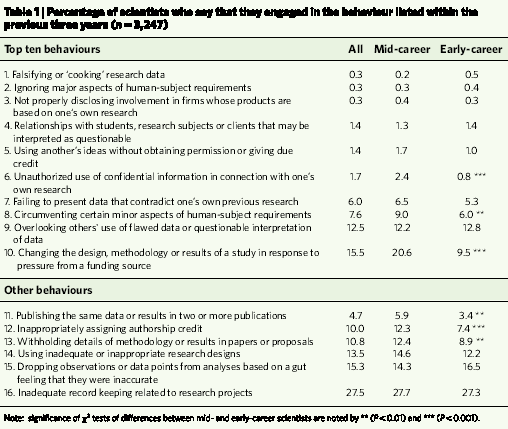
(Table 1). This is the first time such behaviours have been analysed
quantitatively, so we cannot know whether the current situation has always
been the case or whether the challenges of doing science today create new
stresses. Nevertheless, our evidence suggests that mundane regular
misbehaviours present greater threats to the scientific enterprise than those
caused by high-profile misconduct cases such as fraud.
As
recently as December 2000, the US Office of Science and Technology Policy (OSTP)
defined research misconduct as fabrication, falsification, or plagiarism (FFP)
in proposing, performing, or reviewing research, or in reporting research
results[1].
In 2002, the Federation of American Societies for Experimental Biology and the
Association of American Medical Colleges objected to a proposal by the US
Office of Research Integrity (ORI) to conduct a survey that would collect
empirical evidence of behaviours that can undermine research integrity, but
which fall outside the OSTPs narrow definition of misconduct[2],[3]
|
Our findings suggest that US scientists engage in a
range of behaviours extending far beyond falsification, fabrication and
plagiarism. |
We believe that a valuable
opportunity was wasted as a result. A proper understanding of misbehaviour
requires that attention be given to the negative aspects of the research
environment. The modern scientist faces intense competition, and is further
burdened by difficult, sometimes unreasonable, regulatory, social, and
managerial demands[4].
This mix of pressures creates many possibilities for the compromise of
scientific integrity that extend well beyond FFP.
We are not the first to
call attention to these issues debates have been ongoing since questionable
research practices and scientific integrity were linked in 1992 report by the
National Academy of Sciences[5].
But we are the first to provide empirical evidence based on self reports from
large and representative samples of US scientists that document the occurrence
of a broad range of misbehaviours.
The few empirical studies
that have explored misbehaviour among scientists rely on confirmed cases of
misconduct[6]
or on scientists perceptions of colleagues behaviour[7],[8],
or have used small, non-representative samples of respondents[9],[10].
Although inconclusive, previous estimates of the prevalence of FFP range from
1% to 2%. Our 2002 survey was based on large, random samples of scientists
drawn from two databases that are maintained by the NIH Office of Extramural
Research. The mid-career sample of 3,600 scientists received their first
research project (R01) grant between 1999 and 2001.
The
early-career sample of 4,160 NIH-supported postdoctoral trainees received
either individual (F32) or institutional (T32) postdoctoral training during
2000 or 2001.
Getting
data
To assure anonymity, the
survey responses were never linked to respondents identities. Of the 3,600
surveys mailed to mid-career scientists, 3,409 were deliverable and 1,768
yielded usable data, giving a 52% response rate. Of the 4,160 surveys sent to
early-career scientists, 3,475 were deliverable, yielding 1,479 usable
responses, a response rate of 43%.
Our response rates are
comparable to those of other mail-based surveys of professional populations (such
as a 54% mean response rate from physicians[11]).
But our approach certainly leaves room for potential non-response bias;
misbehaving scientists may have been less likely than others to respond to our
survey, perhaps for fear of discovery and potential sanction.
This, combined with the
fact that there is probably some under-reporting of misbehaviours among
respondents, would suggest that our estimates of misbehaviour are conservative.
Our survey was carried out independently of, but at around the same time as,
the ORI proposal. The specific behaviours we chose to examine arose from six
focus-group discussions held with 51 scientists from several top-tier research
universities, who told us which misbehaviours were of greatest concern to them.
The scientists expressed concern about a broad range of specific, sanctionable
conducts that may affect the integrity of research.
To affirm the serious
nature of the behaviours included in the survey, and to separate potentially
sanctionable offences from less serious behaviours, we consulted six
compliance officers at five major research universities and one independent
research organization in the United States. We asked these compliance officers
to assess the likelihood that each behaviour, if discovered, would get a
scientist into trouble at the institutional or federal level.
The first ten behaviours
listed in Table 1 were seen as the most serious: all the officers judged them
as likely to be sanctionable, and at least four of the six officers judged
them as very likely to be sanctionable. Among the other behaviours are several
that may best be classified as carelessness (behaviours 14 to 16).
Admitting to misconduct
Survey respondents were
asked to report in each case whether or not (yes or no) they themselves
had engaged in the specified behaviour during the past three years. Table 1
reports the percentages of respondents who said they had engaged in each
behaviour. For six of the behaviours, reported frequencies are under 2%,
including falsification (behaviour 1) and plagiarism (behaviour 5). This
finding is consistent with previous estimates derived from less robust
evidence about misconduct.
However, the frequencies
for the remaining behaviours are 5% or above; most exceed 10%. Overall, 33% of
the respondents said they had engaged in at least one of the top ten
behaviours during the previous three years. Among
mid-career respondents, this proportion was 38%; in the early-career group, it
was 28%. This is a significant difference (x2
= 36.34, d.f. = 1, P < 0.001). For each behaviour where mid- and
early-career scientists percentages differ significantly, the former are
higher than the latter.
Although we can only
speculate about the observed sub-group differences, several explanations are
plausible. For example, opportunities to misbehave, and perceptions of the
likelihood or consequences of being caught, may change during a scientists
career. Or it may be that these groups received their education, training, and
work experience in eras that had different behavioural standards. The mid-career
respondents are, on average, nine years older than their early-career
counterparts (44 compared with 35 years) and have held doctoral degrees for
nine years longer.
|
Certain features of the working environment of
science may have unexpected and potentially detrimental effects on the
ethical dimensions of scientists work. |
Another possible
explanation for sub-group differences is the under-reporting of misbehaviours
by those in relatively tenuous, early-career positions. Over half (51%) of the
mid-career respondents have positions at the associate-professor level or
above, whereas 58% of our early-career sample are postdoctoral fellows.
Addressing
the problem
Our findings suggest that
US scientists engage in a range of behaviours extending far beyond FFP that
can damage the integrity of science. Attempts to foster integrity that focus
only on FFP therefore miss a great deal. We assume that our reliance on self
reports of behaviour is likely to lead to under-reporting and therefore to
conservative estimates, despite assurances of anonymity. With as many as 33%
of our survey respondents admitting to one or more of the top-ten behaviours,
the scientific community can no longer remain complacent about such
misbehaviour.
Early approaches to
scientific misconduct focused on bad apples. Consequently, analyses of
misbehaviour were limited to discussions of individual traits and local (laboratory
and departmental) contexts as the most likely determinants. The 1992 academy
report5 helped shift attention from individuals with bad traits towards
general scientific integrity and the responsible conduct of research. Over
the past decade, government agencies and professional associations interested
in promoting integrity have focused on responsable conduct in research[12],[13],[14].
However, these efforts still prioritize the immediate laboratory and
departmental contexts of scientists work, and are typically confined to
fixing the behaviour of individuals. Missing from current analyses of
scientific integrity is a consideration of the wider research environment,
including institutional and systemic structures.
A 2002 report from the
Institute of Medicine directed attention to the environments in which
scientists work, and recommended an institutional (primarily university-level)
approach to promoting responsible research[15].
The institutes report also noted the potencial importance of the broader
scientific environment, including regulatory and funding agencies, and the
peer-review system, in fostering or hindering integrity, but remained mostly
silent on this issue owing to a dearth of evidence.
In our view, certain
features of the research working environment may have unexpected and
potentially detrimental effects on the ethical dimensions of scientists work.
In particular, we are concerned about scientists perceptions of the
functioning of resource distribution processes. These processes are embodied
in professional societies, through peer-review systems and other features of
the funding and publishing environment, and through markets for research
positions, graduate students, journal pages and grants. In ongoing analyses,
not yet published, we find significant associations between scientific
misbehaviour and perceptions of inequities in the resource distribution
processes in science.
We believe that
acknowledging the existence of such perceptions and recognizing that they may
negatively affect scientists behaviours will help in the search for new ways
to promote integrity in science.
Little attention has so
far been paid to the role of the broader research environment in compromising
scientific integrity. It is now time for the scientific community to consider
what aspects of this environment are most salient to research integrity, which
aspects are most amenable to change, and what changes are likely to be the
most fruitful in ensuring integrity in science.
NOTAS:

Swazey, J. M., Anderson, M. S. &
Louis, K. S. Am. Sci. 81, 542).
Geggie, D. J. Med. Ethics 27,
344).
Ranstam, J. et al. Control Clin.
Trials 21, 415).
Geggie, D. J. Med. Ethics 27,
344).
Asch, D. A., Jedrziewski, M. K. & Christakis, N. A. J.
Clin Epidemiol. 50, 1129).
Panel on Scientific
Responsibility and the Conduct of Research (Natl Acad., Washington DC,
1992).
Committee on Science Engineering
and Public Policy On Being a Scientist: Responsible Conduct in Research (Natl
Acad., Washington DC, 1995).
Panel on Scientific
Responsibility and the Conduct of Research (Natl Acad., Washington DC,
1993).
|